
The specific version of this problem tends to involve chairs. A dining set arrives, gets assembled on the patio, and only then does it become clear that pulling a chair back far enough to actually sit down means pushing it into the wall. Or into the path between the back door and the garden. Or into the barbecue stand that was already there.
None of this is a quality problem. The furniture does exactly what was described in the listing. The issue was in the planning stage, which often gets skipped when a product looks good enough online to just buy.
What the Space Gets Used For

This is worth settling before looking at products, because the answer changes the brief considerably.
Some outdoor areas are primarily for meals – family dinners in summer, breakfast when the weather is warm enough. Others are used mainly for sitting quietly, for reading, for a morning coffee before the day starts. Some are busy entertaining spaces; others are used only occasionally and mostly just need somewhere to sit when people are out there.
The furniture that suits the actual use tends to be different from the furniture that suits the imagined version of the space. A patio used daily for two people having coffee does not benefit from a six-seat dining set, regardless of how good the set looks.
The Measurement That Usually Gets Missed
Chair clearance is the measurement that catches people out more than any other.
A dining chair needs roughly 75 to 90 centimetres of space behind the seat to pull back and stand up without bumping into anything. At a table for four, this is needed behind every chair at the same time. On a patio with walls or fences on multiple sides, the available table size is often considerably smaller than the total patio area suggests.
Because patio sets can look very different once placed in a real outdoor area, some brands work with a 3d rendering agency to show furniture in complete garden or terrace scenes rather than only in product-on-white photography. Seeing a dining set in a fenced garden with walls and surrounding elements at their actual scale is meaningfully more useful than seeing it against a neutral studio background.
Write down the measurements before browsing. Total area, but also where the doors are and which direction they open, any fixed features that can’t move, and which paths need to stay clear.
What Product Photography Can and Cannot Show
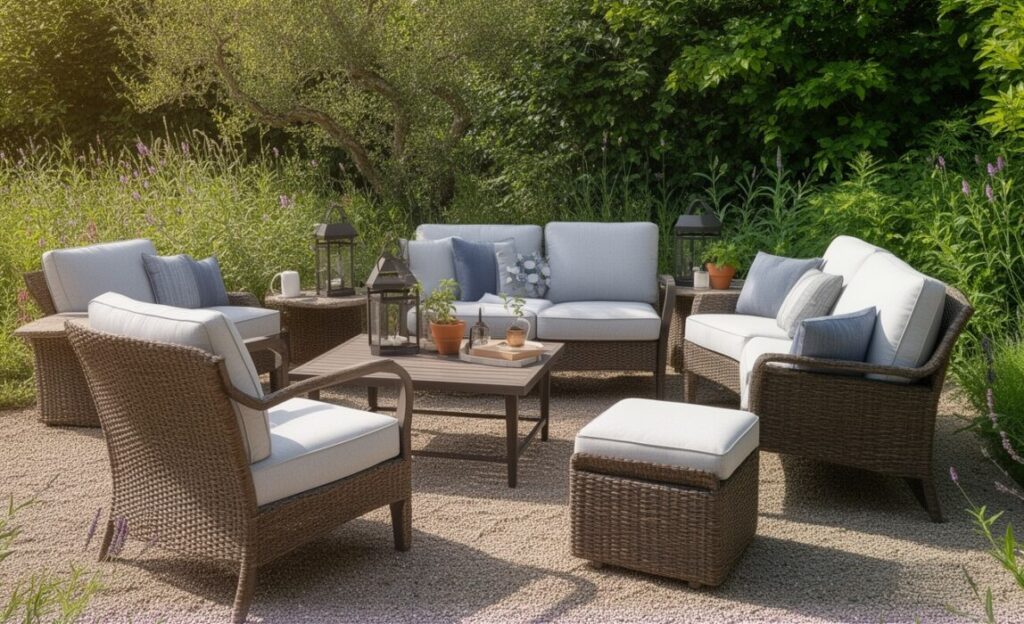
A product shot at a comfortable angle against a plain background communicates what a piece of furniture looks like as an object. It is considerably less useful for understanding how a set will occupy a particular outdoor space.
Lifestyle images set in realistic outdoor environments – a fence or wall visible behind the furniture, a garden surface beneath it, other elements present at their actual scale – show proportion and spatial context in a way that object photography cannot. A view from roughly where a seated person would look is useful. Close-up images of the material surface are also worth looking for: these reveal whether a finish is matte or textured or reflective, and show the actual construction of woven or timber surfaces.
For any set being considered, look for images that show the pieces together rather than individually – the table and chairs in the same frame, or the sofa and coffee table side by side. Prices are usually quoted per item; the relationship between them is only visible when they appear together.
Materials and What They Actually Involve Over Time
Teak develops a silver-grey patina if left without oiling, which happens gradually and is irreversible once it has advanced. Maintaining the original warm tone requires periodic oiling – how often depends on the conditions, but typically once or twice a year. Powder-coated aluminium stays consistent in both colour and structure through wet conditions, and its weight makes it practical to rearrange.
For wicker and rattan products, quality varies more across the category than most people realise before they have purchased a set and watched it change through a summer. The better-grade synthetic products handle UV and wet conditions without significant cracking or fading. The lower-grade ones often give visible signs of deterioration within a single season.
Cushion fabric is worth researching specifically. Solution-dyed acrylic holds colour through UV exposure better than standard polyester, and it tends to dry faster after rain. This is not a trivial difference over several years of outdoor use.
Checking Whether the Layout Will Actually Work
The tape method: mark out the furniture dimensions on the patio surface and walk through the layout as if the pieces were there. Move from the door to the other side. Sit in the approximate position at the table. Check whether circulation feels reasonable from every direction.
For homeowners who struggle to picture dimensions from a product page alone, augmented reality furniture tools can help preview whether a chair, table, or sectional will feel too large or too small in the actual outdoor space. This is only available from some retailers, but worth looking for before committing to anything large.
Comfort
Outdoor furniture that is uncomfortable gets used less than outdoor furniture that is comfortable. This is a fairly simple observation, but comfort is easy to deprioritise when browsing online because there is no way to try a chair from a product page.
Seat depth matters for lounge furniture – very deep seats can be difficult to get out of, especially for older users or anyone with mobility limitations. The relationship between table height and chair height matters for dining furniture – a few centimetres of mismatch accumulates into real discomfort over a long meal. Back support and armrest height become more noticeable the longer someone sits in a chair.
If there is any possibility of trying the furniture in person before ordering, it is usually worth doing.
Storage and Off-Season Care
How the furniture will be managed outside the warm months is worth thinking through before purchase. Some materials and constructions handle being left outside year-round without significant deterioration; others need covers or indoor storage to maintain their appearance.
Cushions almost always need somewhere dry to go when not in use, which means either an outdoor storage box or a shed with enough space. A set of chairs that stack or fold takes up considerably less storage room than one that does not, which can be a practical deciding factor when storage space is genuinely limited.
Fitting the Furniture to the Space
Smaller outdoor areas often work best with less furniture than the available floor space could hold.
A compact patio arranged around a single comfortable seating group – two or three pieces chosen for the primary use of the space – is easier to be in than one where the furniture fills every available area. Over-furnished outdoor spaces tend to feel constrained rather than abundant, and the furniture that sits at the edges often goes unused.
The question worth asking before buying is whether the set, once assembled, will leave the outdoor area feeling like somewhere to spend time – or like a room that is mostly taken up by furniture.
