
Most homeowners judge landscaping by curb appeal, a tidy lawn and a few well-placed shrubs near the entryway. But yard design does more than shape how a house looks from the street. It decides where water goes every time it rains, and that decision shapes how well a house holds up over time. A yard that looks polished but ignores water flow often hides a problem, one that only shows up once the first hard rain exposes where the design falls short.
Water is patient. It doesn’t need a storm to cause damage, and a slow, steady trickle in the wrong direction, repeated over dozens of rain events a year, can undermine soil stability and erode plant beds. Over time, it also saturates the ground around a house’s perimeter, applying pressure on foundation walls. Landscaping chosen purely for looks, without drainage in mind, is one of the more common ways homeowners create long-term water problems that often require more serious interventions such as foundation repair. By the time the effects show up, the fix is usually bigger than it would have been at the planning stage. That’s why drainage planning belongs at the same early stage as plant selection and hardscaping choices.
- When Drainage Fails, Water Damage Follows
- Grading Is the First Line of Defense
- The Foundation Connection
- Choosing Plants That Support Drainage
- Downspout Placement Matters as Much as Gutters
- Permeable Hardscaping Outperforms Solid Surfaces
- French Drains, Swales, and Dry Wells
- The Cost of Waiting
- Tying Your Gutter System Into a Drain
- Seasonal Drainage Maintenance
- DIY vs. Professional Help
- The Bottom Line
- Similar posts:
When Drainage Fails, Water Damage Follows
When a yard doesn’t shed water properly, the consequences usually show up indoors before anyone notices what’s happening outside. Water that pools against exterior walls works through hairline cracks and window wells, and it seeps through porous foundation materials too. The result is damp basements and warped flooring, and mold often grows behind the walls as well. In more severe cases, homeowners end up needing water damage restoration to fix damage that better yard grading and plant placement could have prevented from the start.
Grading Is the First Line of Defense
Grading is the single most important (and most overlooked) element of residential drainage. The ground immediately surrounding a house should slope away from the foundation, ideally dropping at least six inches over the first ten feet. This slope gives gravity a job, moving runoff toward lawns and swales before the water has a chance to pool against the walls. Storm drains handle the overflow when a swale alone isn’t enough.
Many older homes have lost this slope over decades of soil settling and mulch buildup. Poorly planned landscaping additions make the problem worse in newer yards, too. That’s why a grading check is one of the first things worth doing before any new plant beds or hardscaping go in. Standing water near a foundation twenty-four hours after a storm is usually the clearest sign that regrading is overdue. Catching the problem at that stage is far cheaper than waiting a full season for it to soften the soil beneath a walkway or patio.
The Foundation Connection
Soil that stays saturated for extended periods doesn’t just threaten a home’s interior. It puts direct pressure on the structure itself. Wet, clay-heavy soils expand and swell, pushing laterally against foundation walls in a process known as hydrostatic pressure. Over time, this pressure can crack concrete and shift footings. Uneven settling often follows close behind.
This is a particular concern in regions with expansive clay soils and heavy seasonal rainfall, where the ground swells in wet months and shrinks back in dry ones. Grading and plant placement matter, and so does where the downspouts empty. That’s why so many local foundation repair jobs trace back to a drainage issue that started in the yard.
Choosing Plants That Support Drainage
Plant selection plays a bigger role in drainage than most people assume. Deep-rooted trees and shrubs planted too close to a foundation can actually worsen soil movement, since their roots draw moisture unevenly from the ground and create dry pockets that later refill and expand. The right plants, however, work differently. Fibrous, shallow root systems, the kind found in ornamental grasses and sedges, absorb excess surface water and slow it down before it reaches the house. Native perennials do similar work in beds farther from the foundation.
Rain gardens (landscaped areas set in the natural low points of a yard and filled with water-absorbing vegetation) put this into practical use. They catch runoff and let it filter through soil and roots. By the time any of the water streams nears the foundation, it has slowed to a trickle. Species suited to occasional standing water keep these low spots functional. Plants that need consistently dry soil, on the other hand, can turn a rain garden into a dead zone, or worse, a breeding ground for mosquitoes.
Downspout Placement Matters as Much as Gutters
Downspout placement deserves its own attention, separate from the gutters themselves. A downspout that simply dumps water at the base of the wall can undo the benefit of good grading almost immediately, even with a functioning gutter system feeding it. Extending downspouts with rigid or flexible piping, so they discharge four to six feet from the foundation, spreads that volume out and keeps it away from one vulnerable spot. Routing them into a landscaped swale works too. Splash blocks help in the short term, but they’re a partial fix at best. On sloped properties or in yards with heavy clay soil, a proper extension does far more of the work.
Permeable Hardscaping Outperforms Solid Surfaces
Hardscaping decisions matter just as much as plant choices. Traditional concrete and asphalt surfaces are impermeable, and every drop of rain that lands on them has to go somewhere else, usually toward the nearest low point, which is too often the house itself. Permeable pavers and gravel paths work differently. Porous patio materials do too. Water soaks into the ground where it falls, so it never gets the chance to pool elsewhere on the property. Homeowners weighing patio or walkway materials can use this breakdown to see how different drainage systems handle surface versus subsurface water before deciding which surfaces make sense for their specific yard.
French Drains, Swales, and Dry Wells
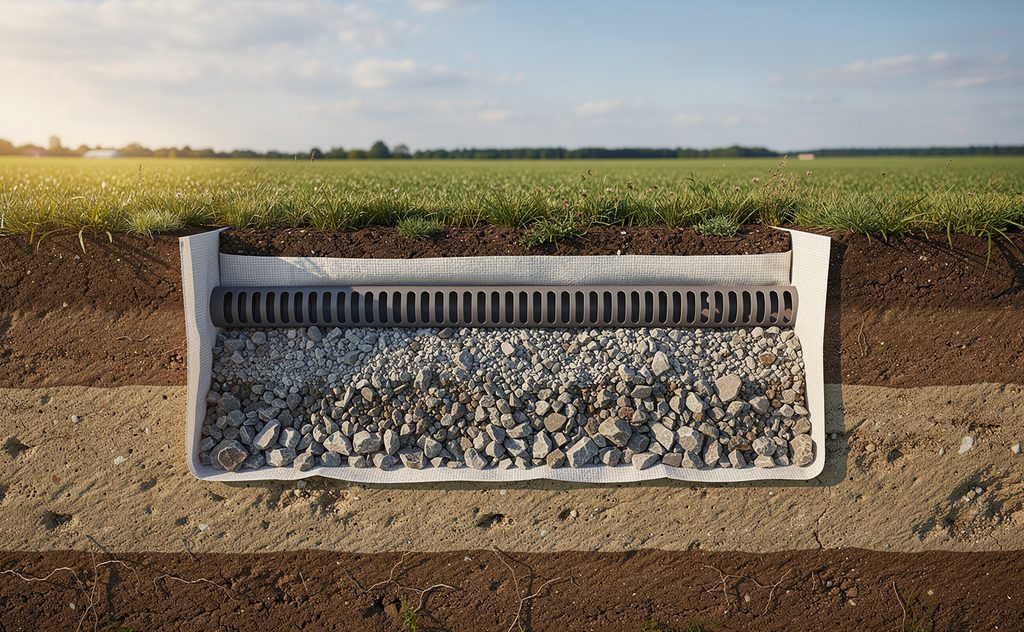
For yards where grading and plant selection alone aren’t enough, mechanical drainage systems fill the gap. French drains (trenches lined with gravel and a perforated pipe) intercept groundwater before it reaches vulnerable areas and reroute it to a safe discharge point. Swales, which are shallow, vegetated channels, move surface water across a property without erosion. Dry wells collect runoff underground and let it disperse gradually into surrounding soil. However, keep in mind that none of these systems work well in isolation. Instead, they work best as part of a broader landscape plan, put in place early, before any water damage occurs.
The Cost of Waiting
Cost is usually the deciding factor in whether homeowners address drainage proactively or reactively. Regrading a yard or adding a French drain typically runs a few hundred to a few thousand dollars, and the exact number depends on the scope of the work. Extending downspouts costs far less, often under a couple hundred dollars in materials.
Repairing a cracked foundation or remediating a mold-damaged basement, by comparison, routinely costs many times that amount, and it often disrupts the household for weeks. Drainage work functions less like a landscaping expense and more like insurance that happens to also improve how the yard looks and works day to day.
Tying Your Gutter System Into a Drain
Gutters and downspouts link a home’s roof to its landscaping, and they’re frequently mismatched with the yard beneath them. A downspout that empties two feet from the foundation defeats the purpose of even a well-graded yard, since it deposits a concentrated volume of water in exactly the spot that needs to stay dry. This is why it’s worth checking whether a gutter system should tie into a buried drain line before assuming the landscaping alone will handle roof runoff. This design choice matters most on properties with large roof areas or minimal side-yard space for surface drainage.
Seasonal Drainage Maintenance
Maintain your drainage systems regularly, especially at the start of each season. Clear debris from gutters before the fall and spring rains to prevent clogged water from overflowing into your foundation. Additionally, check and refresh mulch beds to keep a proper slope, as mulch naturally compacts and washes away over time. Other additions, such as French drains and dry wells, also benefit from an annual inspection to confirm they haven’t silted up or become blocked by root intrusion.
Check your downspout drainage every season to ensure water flows toward lawns or gardens rather than paved surfaces, which can channel runoff right back toward your foundation. Keep in mind that landscaping updates (such as new plant beds or modified hardscaping) can easily disrupt your existing drainage paths. Over time, naturally shifting soil can also cause these exact same drainage failures.
DIY vs. Professional Help
Some drainage fixes are well within reach for a homeowner with a weekend and a shovel, whether it be extending a downspout or refreshing mulch to restore proper grading. Adding a shallow swale across a low corner of the yard also falls into this category. However, other jobs are better suited to someone who does this work regularly, such as excavating near a foundation or diagnosing why a French drain has stopped working. A landscaper or a drainage contractor can spot problems a homeowner might miss, like a slope that looks fine to the eye but actually tilts toward the house by a fraction of an inch. That is why having a professional review your yard first is a smart move; a quick second opinion is much cheaper than tearing out and redoing your brand-new hardscaping later on.
The Bottom Line
Landscaping and drainage aren’t separate line items on a home improvement checklist. Instead, they function as one system. A beautifully designed yard that ignores water flow works against the house it surrounds, while a well-graded, thoughtfully planted property does the opposite, protecting the structure it complements. Homeowners who plan these two elements together tend to avoid the far more expensive repairs that come from years of unmanaged water finding its way exactly where it shouldn’t.
