
You can spend a whole season getting the planting right, the borders layered, the colors timed to bloom in sequence, and still have the garden feel unfinished the moment your eye lands on the patio.
Paving is what the space is viewed from and walked across, yet outdoor tile is often the last thing chosen and the first place a design quietly falls apart.
Picking it well is less about finding something that survives the weather and more about choosing a surface that belongs to the garden it sits in. Here is how to approach the decision so the patio reads as part of the landscape rather than a slab bolted onto it.
Why cohesion comes before the tile
Before comparing samples, decide what the patio should do for the garden.
A cohesive outdoor space shares a visual thread across its parts: paving, planting, walls, and furniture that feel drawn from the same palette.
When the tile fights the foliage or the color of the house, the eye catches on the seam. When it echoes a tone already present in the stone, brick, or leaves, the space settles.
Start by naming the two or three materials the garden already commits to, then choose a tile that sits comfortably beside them rather than one that competes for attention.
What should outdoor tiles actually withstand?
Beauty is only half of an exterior specification. Outside, a tile answers to weather in ways an interior floor never does, and three properties matter most.
Freeze-thaw resistance keeps water absorbed into the tile body from expanding and cracking it over successive winters, so cold-climate patios need tiles rated for repeated freezing and with low water absorption.
Slip resistance, measured as a Dynamic Coefficient of Friction (DCOF), matters wherever the surface gets wet; poolside and entry zones generally call for more traction than a covered interior floor.
And UV and heat stability decide whether a color holds or fades, and how hot the surface becomes underfoot in full sun.
Drainage sits underneath all of it.
Even a perfect tile fails on a patio that pools water, so the base needs a slight fall (commonly around one to two percent) and a drainage strategy suited to your soil; our types of drainage system guide is a useful primer before you set anything in mortar.
Reputable exterior-tile suppliers publish this performance data openly. Brands like OUTERclé outdoor tiles organize their entire range around these realities, from freeze-thaw and DCOF to submerged use in pools and fountains.
This application-led approach helps homeowners and designers narrow their choices according to where the tile will be installed, rather than selecting on appearance alone.

How do you match tiles to your climate and site?
The most common outdoor-tile mistake is choosing for the photo rather than the place.
A surface that flatters a dry, sun-baked courtyard can behave very differently in a humid, freeze-prone yard.
Deborah Osburn, founder of clé and its outdoor sister brand OUTERclé, put it plainly when describing why exterior material selection is so technical: “what is perfect in Joshua Tree is likely not applicable in Connecticut.”
Weather starts changing most materials the day after they are installed, and a tile chosen without regard for local climate tends to reveal that mismatch fast.
Before committing, map your conditions: how cold winters get, how much direct sun the patio takes, whether the ground sits wet, and whether any area will be submerged or driven over.
Match the tile’s rated use to those answers, not to the mood of a showroom image.
Choosing tiles that tie the garden and patio together
Once performance is settled, cohesion comes down to a few practical choices.
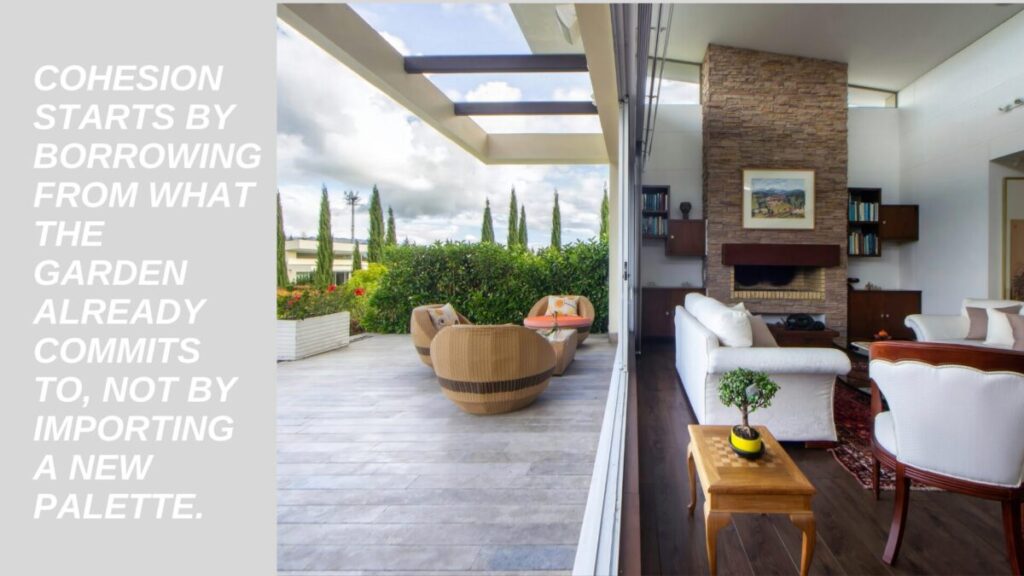
Material continuity is the most reliable tool: repeating a material or tone across the threshold so an interior floor and an outdoor terrace share a family resemblance makes a home and garden read as one space.
It is the same principle behind designing a kitchen that connects to your garden, where shared flooring dissolves the line between inside and out.
- Color is best borrowed from what is already present: the warm range of a brick wall, the grey of local stone, the greens and terracottas of the planting.
- Scale and layout matter too. Larger formats read calm and contemporary across an open terrace, while smaller, patterned tiles suit a courtyard moment or a defined seating zone.
- Plan the tile module against the actual patio dimensions to avoid thin, awkward slivers at the edges, and treat the points where paving meets lawn, planting, or steps as part of the design.
Handling those transitions early, in the spirit of site-responsive design, is what separates a considered garden from a patchwork one.
A quick checklist before you buy
Run through this before ordering:
- Order samples and view them outdoors, in real light, next to your existing materials.
- Confirm the freeze-thaw rating and water-absorption figure if you have cold winters.
- Check the DCOF value for any wet or poolside areas, and have slip-sensitive installs handled by a qualified installer.
- Plan drainage and a slight slope into the base before setting begins.
- Ask about sealing and maintenance for porous materials like terracotta and cement.
- Confirm lead times early, since artisan or made-to-order outdoor tile can take weeks to arrive.
The bottom line
Choosing outdoor tile well is really an exercise in restraint and context.
The most cohesive spaces are not the ones with the boldest paving; they are the ones where the tile looks inevitable, drawn from the same palette as the planting and engineered for the climate it lives in.
Settle the performance, borrow the color from the garden, plan the transitions, and the patio stops being a separate project and becomes the surface that holds the whole space together.
