
Spend enough time scrolling home renovation accounts and you’d think every backyard needs a pizza oven, a built-in bar, and Edison bulbs strung across a custom cedar pergola. Reality is messier. Most people want somewhere comfortable to eat outside, maybe grill something, maybe have a few people over. That’s achievable without a $40,000 contractor quote but it does require thinking before buying anything.
Here’s what actually matters.
- Figure Out the Function First, or Waste Money Later
- Sun Is the Thing Nobody Checks Until It’s Too Late
- Size the Space Generously
- Zones Make Small Spaces Work Like Bigger Ones
- The Grill Setup That Actually Gets Used
- Lighting Turns a Patio Into Somewhere People Stay
- What Furniture Survives and What Doesn’t
- Designing Outdoor Space That Actually Gets Used
- Similar posts:
Figure Out the Function First, or Waste Money Later
Before any measurements, any mood boards, any trips to the garden center – one question. What is this space actually for?
Not hypothetically. Not “we’d love to host big dinners” if that’s happened twice in five years. Realistically. A couple who grills on weeknights and occasionally has six people over needs a completely different setup than a family that wants a permanent kids’ play zone with seating for adults on the edges.
Contractors who build these spaces professionally use field service software to plan jobs, track materials, and coordinate crews across multiple projects. Even at the residential level, the logic holds – you need a list of what goes where before anything gets ordered or dug up.
Get that list first. Everything else follows from it.
Sun Is the Thing Nobody Checks Until It’s Too Late
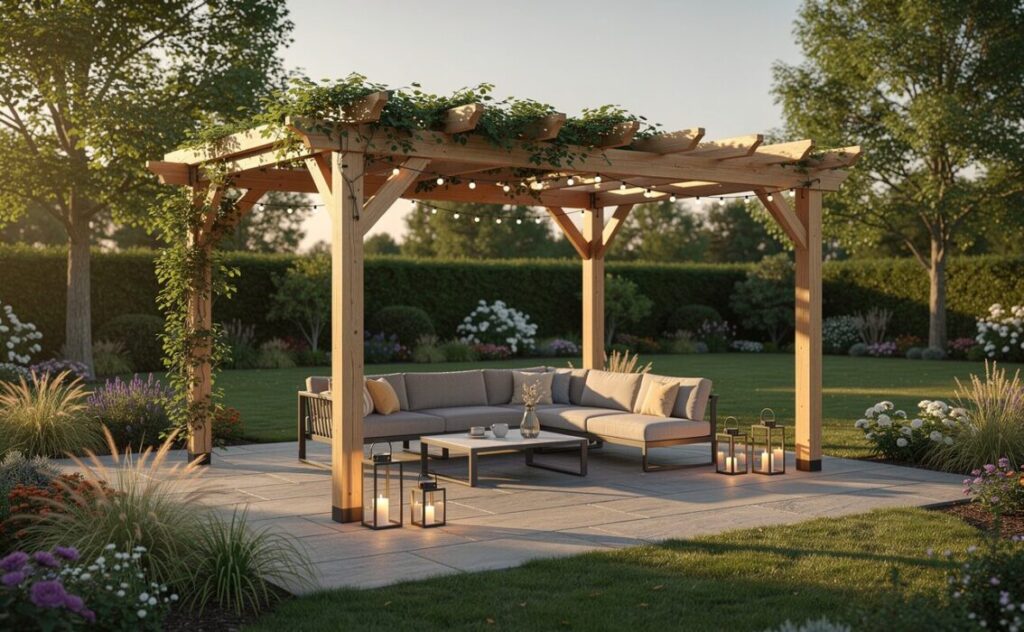
Walk to where the patio is going. Stand there at 5 PM on a summer day, or if that’s not possible, use a sun tracking app – Sun Surveyor or Shadowmap both work well for this.
West-facing patios with no overhead cover are miserable from June through September during the exact hours people want to use them. This is not a minor inconvenience. It’s the reason expensive outdoor furniture gets abandoned and eventually thrown out.
Shade solutions range from $200 shade sails that go up in two hours to motorized louvered pergolas from companies like Struxure that adjust via app and start around $8,000 installed. Most people land somewhere in the middle – a pergola frame with polycarbonate panels, which blocks UV and handles rain without making the space feel enclosed. It works. It doesn’t look temporary.
Whatever the budget, sort the shade before buying a single chair.
Size the Space Generously
A dining table for six with chairs pulled out needs at least 12 by 14 feet – and that’s snug. Add a grill station beside it and the math climbs fast.
Most people undersize patios. Then they spend two summers bumping into furniture before accepting the space doesn’t work and starting over. Pour the concrete or lay the pavers correctly the first time. It’s the one part of this that’s genuinely hard to fix later.
On surface materials: travertine looks expensive because it is, gets hot in direct sun, and requires sealing. Composite decking stays cooler underfoot and needs almost no maintenance. Concrete is the most forgiving – cheap to pour, easy to resurface, takes stain or stamping if plain gray feels too industrial. None of these are wrong choices. They’re just different trade-offs that depend on climate, budget, and how much maintenance feels acceptable.
Zones Make Small Spaces Work Like Bigger Ones
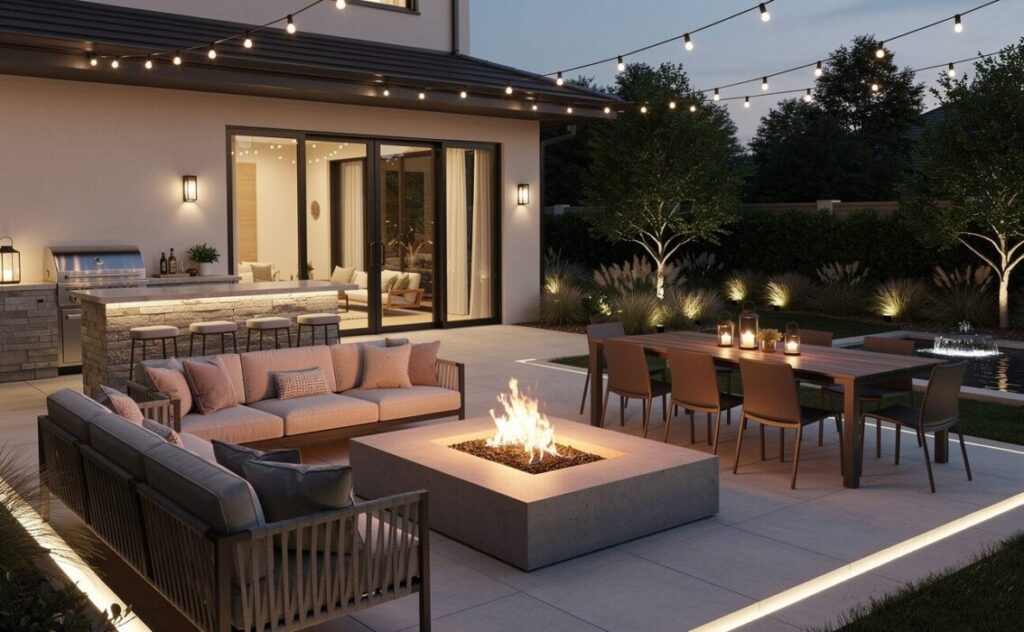
The idea is simple enough. Cooking stays in one area, eating in another, sitting-around-doing-nothing in a third. When these overlap (grill parked at the corner of the dining table, chairs crammed against the fence) everything feels cramped even if there’s plenty of square footage.
A surface change handles the transition without walls or fences. Pavers in the cooking and dining zone, wood decking or gravel in the lounge area. Planting beds along the edges do the same thing with greenery instead of hardscape. Both options are cheaper than building anything structural.
One thing worth knowing about grill placement specifically: position it so smoke doesn’t drift toward the seating area when the wind is coming from the most common direction. Check that on a few different days before anything gets built in permanently.
The Grill Setup That Actually Gets Used
A freestanding grill on wheels is fine. Most of the time, it’s the smarter call – moveable, no complicated installation, swappable when a better model comes out. Weber Kettle, Traeger Ironwood, Big Green Egg for those who want ceramic. All of them cook well. None of them require a built-in cabinet surround to function.
What genuinely improves the experience isn’t the grill itself. It’s what’s around it. A prep surface at counter height – not a wobbly side table. Overhead lighting directly above the grate, because grilling after dark with no task lighting is genuinely annoying. A small fridge within arm’s reach. Even a 50-liter unit changes the whole rhythm of cooking outside.
Built-in outdoor kitchens with Lynx or DCS grill heads and concrete countertops look impressive. They also start at $10,000 before installation and require a gas line. For most backyards, the freestanding setup does 90% of the same job at 20% of the cost.
Lighting Turns a Patio Into Somewhere People Stay
One overhead fixture and the whole thing looks like a petrol station forecourt after dark. Not exactly the atmosphere anyone’s going for. Three layers fix this.
- First – ambient. String lights across a pergola frame, a couple of lanterns, low deck lighting that produces a general warm glow. Nothing harsh. Warm white around 2700K, not the blue-white that makes faces look vaguely unwell. String lights are still the fastest way to make an outdoor space feel finished, and they remain popular for one simple reason: they work.
- Second – task lighting. Brighter, directional, over the grill and over the dining table. Enough to actually see what’s being cooked. Not a spotlight, just functional.
- Third – accent. Uplights at the base of trees, path lighting along the ground, a soft glow under step edges. This is the layer that makes a space look like someone thought about it rather than just assembled it over a weekend.
Low-voltage LED path lighting from brands like VOLT or Kichler doesn’t need an electrician – transformer on a standard outlet, wires tucked under mulch, done in an afternoon. Anything hardwired is a different story. Get a licensed electrician. Outdoor wiring done wrong isn’t a code technicality. It’s a fire.
What Furniture Survives and What Doesn’t
Teak holds up outdoors for decades. Untreated it goes silver-gray, which some people prefer. Oiled once a year it stays warm brown. The downside is cost – a solid teak dining table from a reputable source runs $1,500 to $3,000.
Powder-coated aluminum costs less, weighs less, and doesn’t rust. Most of the furniture at Restoration Hardware Outdoor and Serena & Lily is aluminum frames with cushions. It looks good and lasts.
HDPE resin wicker holds up fine outdoors. Natural rattan is a different story. It deteriorates in moisture and UV unless it lives somewhere genuinely dry and gets stored every winter. Most people don’t store their outdoor furniture every winter.
Cushion fabric matters more than most people expect. Sunbrella is the standard – rated for thousands of hours of UV exposure, resistant to mildew. Off-brand polyester cushions fade in one season and smell bad in the second. Spend the money once.
Buy fewer pieces than instinct suggests. A crowded patio feels smaller than an empty room. Four good chairs and a table that fits the space beats eight mediocre chairs pushed up against each other.
Designing Outdoor Space That Actually Gets Used
The best outdoor entertaining spaces have one thing in common – they match how people actually live, not how they imagine they might.
A patio built around real habits gets used in September. One built around aspirations gets used twice in June, then ignored.
Get the sun right. Size it generously. Sort the shade before buying furniture. Layer the lighting. Put fragrant plants where people sit.
None of that requires a big budget or a contractor. It requires decisions made in the right order.
Everything else is details.
