
Selecting the wrong layout or material can instantly throw a room out of proportion. A rug that is too small can make a spacious living room look awkward and fragmented, while an overly fragile fabric can wear out within months under heavy foot traffic. Navigating how to choose the perfect rug for your home in 2026 requires looking beyond surface patterns and mastering the interplay among spatial geometry, pile height, and advanced textile engineering. Follow this comprehensive guide to find the ultimate foundation for your space.
- The Area Rug Selection Matrix (Traffic vs. Fiber)
- 1. Master the Laws of Room Scale and Proportion
- 2. Match Fiber Engineering to Your Real-World Lifestyle
- 3. Understand Pile Height and Visual Weight
- 4. Coordinate Patterns and Textures Inward
- 5. Never Skip a High-Quality Rug Pad
- The Three-Step Tape Test
- Frequently Asked Questions
- Similar posts:
The Area Rug Selection Matrix (Traffic vs. Fiber)
| Placement Zone | Traffic Level | Recommended Pile Height | Ideal Fiber Construction |
| Living Room | High / Social | Medium (1/4″ to 1/2″) | Wool, Wool-blends, or Performance synthetics |
| Dining Room | High / Spills | Low / Flatweave (< 1/4″) | Smooth polypropylene or tight cotton weaves |
| Bedroom | Low / Barefoot | High / Plush (> 1/2″) | Shag, Long-pile wool, or Luxury faux-silk |
| Entryway / Hall | Critical / Mud | Low / Flatweave (< 1/4″) | Coir, Sisal, or High-performance washable knits |
1. Master the Laws of Room Scale and Proportion
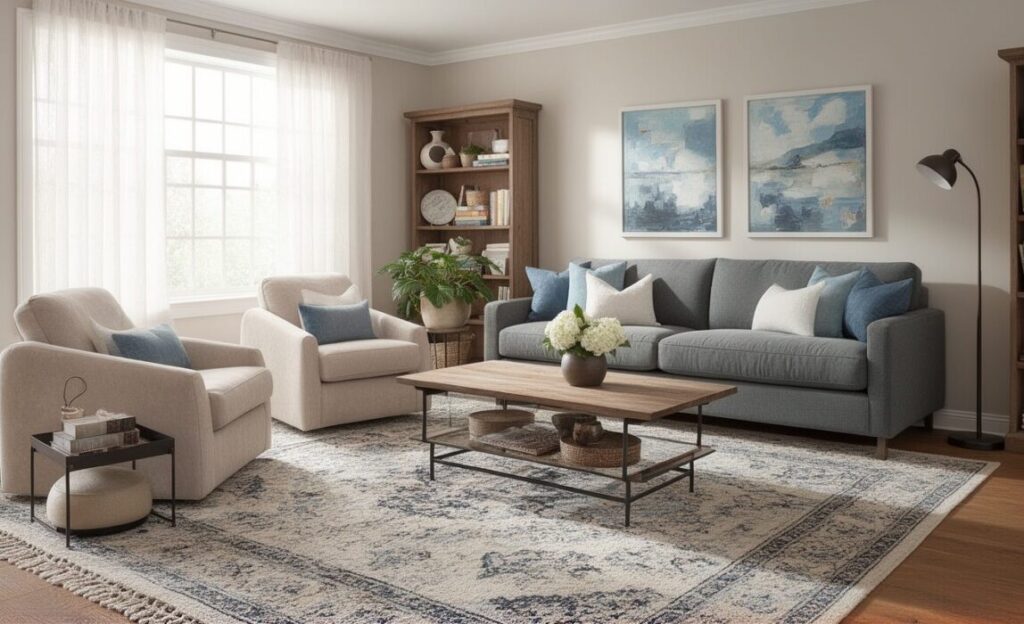
The single most common mistake homeowners make is purchasing a rug that is far too small for their space. When a rug floats in the middle of a room without touching any furniture, it shrinks the room’s visual boundary, making the overall architecture feel cramped.
- The Living Room Blueprint: Your rug should be large enough to ground your main seating arrangement. Ideally, all four legs of your sofa and accent chairs should rest comfortably on the rug. If space is tight, follow the “front legs only” rule – ensure the front feet of every seating piece sit at least six to eight inches over the outer border of the rug to lock the layout together.
- The Bedroom Blueprint: A bedroom rug should extend at least 24 to 36 inches past the sides and foot of your bed, giving your feet a soft place to land every morning. Avoid stopping the rug halfway down the mattress, as it throws off the bed’s structural symmetry.
2. Match Fiber Engineering to Your Real-World Lifestyle
Before falling in love with a delicate pattern, run a realistic audit of your household’s daily activities. If you have energetic toddlers, messy pets, or host regular weekend dinner parties, your flooring needs to be incredibly resilient.
Modern textile innovations have completely transformed home design by introducing ultra-durable, stress-free options. When outfitting busy focal points like kitchens, high-traffic hallways, or entryways, many homeowners prefer machine washable rugs for everyday use because they effortlessly blend premium style with high-utility maintenance. These advanced designs feature lightweight, stain-repellent fibers integrated with a non-slip backing, allowing you to roll up the entire rug and throw it into a standard home washing machine whenever spills, mud tracks, or pet accidents happen.
3. Understand Pile Height and Visual Weight

A rug’s “pile” refers to the density and thickness of its individual fibers. Pile height dictates both the tactile sensation underfoot and the literal visual weight of the textile within your room.
High-Plush Shag vs. Low-Profile Flatweave
| Performance Attribute | High-Plush Shag & Deep Piles | Low-Profile Technical Flatweaves |
| Tactile Sensation | Cloud-like softness; maximum warmth | Firm, smooth, and highly stable surface |
| Vacuum Maintenance | Requires specialized brush attachments | Effortless to vacuum or sweep clean |
| Furniture Mobility | High friction; causes heavy furniture to dip | Perfect for rolling desk or dining chairs |
| Stain Susceptibility | Traps deep dust particles, hair, and crumbs | Repels debris on the surface for fast cleanups |
4. Coordinate Patterns and Textures Inward
When discovering choosing the perfect rug for your home, view the flooring as a canvas that interacts directly with your existing furniture textures.
- If your room is packed with patterns: If your couch features a bold striped pattern or your walls are covered in dense wallpaper, select a solid-colored or highly muted tonal rug to give the eyes a peaceful place to rest.
- If your room features clean minimalism: If your furniture consists of sleek, monochromatic leather and flat wood grains, introduce visual depth by picking a rug with heavy texture-such as a chunky braided wool loop or a geometric high-low carved pile.
5. Never Skip a High-Quality Rug Pad
A rug pad is a non-negotiable component of any flooring installation. Many people assume a pad is only necessary to prevent a rug from slipping on slick hardwood, but it serves multiple structural preservation purposes.
A premium felt or rubber pad acts as a shock absorber, taking the brunt of heavy footsteps and furniture weights. This prevents the primary rug fibers from crushing down against hard subflooring, effectively doubling the lifespan of your textile. Furthermore, pads insulate your home by absorbing sound waves and creating a soft, protective barrier that guards your hardwood floors against scratches.
The Three-Step Tape Test
To implement this guide on choosing the perfect rug for your home flawlessly before spending any money, perform this quick physical diagnostic check in your space:
- Map the Outlines with Tape: Use blue painter’s tape to mark the exact perimeter of your target rug dimensions directly onto your floor.
- Test the Furniture Placement: Place your chairs, sofas, and coffee tables directly over the taped lines to verify that your layout looks completely balanced.
- Check for Door Clearance: Open and close every door that swings near the taped zone. Measure the gap between the bottom of the door and the floor to ensure your chosen pile height won’t clip or jam the door frame during daily use.
Frequently Asked Questions
1. Should an area rug match the color of the couch?
Not exactly. Your rug should complement your couch rather than match it identically. If you have a charcoal grey sofa, a matching charcoal grey rug will cause your furniture to blend into the floor completely. Instead, pick a contrasting rug shade, such as an off-white, cream, or light grey, that shares subtle charcoal accent threads inside the weave to pull the look together.
2. How do I get wrinkles and creases out of a brand-new rug?
Rugs that have been tightly rolled up for shipping frequently suffer from curled edges and stubborn creases. To smooth them out, lay the rug completely flat in a warm room for a few days. If the corners refuse to drop, place heavy books on them or gently roll the edges backward in the opposite direction of the curl.
3. Are wool rugs better than synthetic rugs?
Natural wool is considered the gold standard for luxury area rugs because it is incredibly resilient, naturally stain-repellent due to internal lanolin oils, and can last for decades. However, high-performance synthetic materials (like premium polypropylene or polyester) are significantly more affordable, hypoallergenic, and ideal for areas that require regular machine washing.
