
Storms can place heavy stress on trees, even when the damage is not obvious at first. Strong wind, saturated soil, lightning, and falling debris may weaken roots, split trunks, or leave large branches hanging above homes and walkways. Some trees recover with proper care, while others become an immediate safety risk. When a tree threatens people, buildings, roads, or utilities, professional emergency tree removal may be needed to secure the area and prevent further damage.
- Look for Sudden Leaning
- Check for Exposed or Lifted Roots
- Watch for Hanging Branches
- Inspect the Trunk From a Safe Distance
- Notice Changes in the Canopy
- Treat Power Lines as an Emergency
- Check Access Routes and Structures
- Document the Damage Safely
- Know When a Tree May Be Saved
- Reduce Risk Before the Next Storm
- Put Safety First
- Similar posts:
Look for Sudden Leaning
A tree that begins leaning after a storm may have lost support below the soil. This can happen when strong winds shift the root plate or when heavy rain softens the ground around the roots.
A slight lean does not always mean the tree will fall. The level of concern rises when the change appears suddenly or when the soil lifts, cracks, or forms a mound near the base.
Keep people and pets away from the area. Do not try to push, brace, or straighten the tree. A trained arborist can inspect the roots, trunk, crown, and nearby targets before deciding whether the tree can remain in place.
Check for Exposed or Lifted Roots
Healthy roots help anchor a tree during wind and rain. When roots break or pull out of the ground, the tree may lose much of its stability.
Watch for exposed roots, fresh gaps in the soil, raised ground, or movement around the base. These signs deserve prompt attention, especially when the tree stands near a house, driveway, sidewalk, or play area.
Avoid walking or driving close to the root zone. Added pressure may disturb loose soil or place more stress on damaged roots.
Watch for Hanging Branches
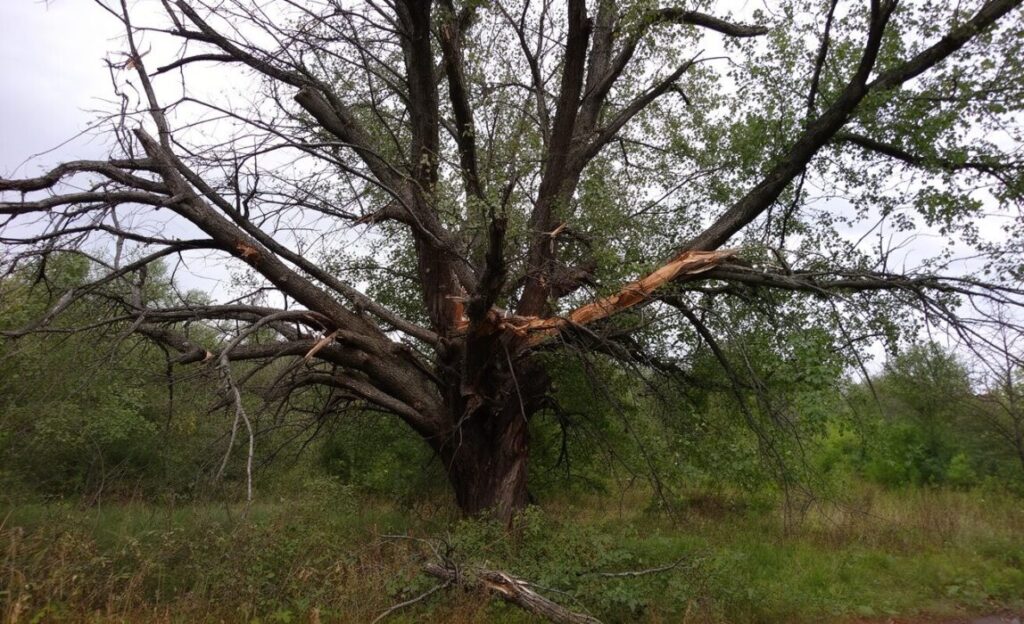
Large broken limbs can remain caught in the canopy after a storm. They may look secure from the ground, yet wind or gravity can cause them to fall without warning.
Look for branches with fresh breaks, loose bark, torn wood, or unusual angles. Smaller limbs may also hide larger cracks where they connect to the trunk.
Never stand beneath a damaged canopy to inspect it. Do not climb the tree or use a ladder near hanging branches. Arborists use trained crews and proper equipment to remove damaged limbs while controlling how and where they fall.
Inspect the Trunk From a Safe Distance
Storm damage can create splits, cracks, and torn sections in the trunk. Some cracks remain visible, while others appear where two large stems meet.
A fresh split may expose pale wood or create a gap that opens when the wind moves the crown. Long cracks that extend down the trunk may point to serious structural weakness.
Trees with several main stems may face greater stress when one section pulls away from another. Professional assessment is important because the visible damage may represent only part of the problem.
Notice Changes in the Canopy
The canopy can reveal signs that a tree has become unstable. A large section may appear lower than before, lean toward a building, or move differently from the rest of the tree.
Uneven weight can place added pressure on damaged roots and trunk unions. This often happens when a storm removes limbs from one side while leaving the other side full and heavy.
An arborist may recommend careful pruning when enough healthy structure remains. Severe damage may leave too little stable wood to support the crown safely.
Treat Power Lines as an Emergency
A tree or branch touching a power line can create a life-threatening hazard. Electricity may move through wet wood, metal fences, tools, or the ground around the tree.
Stay far away and prevent others from entering the area. Do not touch the tree, branch, wire, or nearby objects. Contact emergency services or the local utility provider and follow their instructions.
Tree crews should not begin work near live electrical equipment until the utility has made the area safe. This type of situation requires coordinated action from trained professionals.
Check Access Routes and Structures
Fallen trees and broken limbs can block roads, driveways, doors, and emergency access points. They may also rest on roofs, vehicles, fences, or outdoor equipment.
Do not enter a damaged structure or walk beneath a tree supported by a building. The load may shift as branches settle or as crews begin moving debris.
If everyone can leave the area safely, create distance and wait for professional help. When a tree blocks the only exit or creates an immediate threat, contact local emergency services.
Document the Damage Safely
Photographs can help property owners, tree professionals, and insurance representatives understand what happened. Take pictures only from a safe location.
Capture the whole tree, the visible damage, the surrounding property, and any affected structures. Note when the storm occurred and when you first noticed the problem.
Avoid delaying urgent safety action to collect more images. Protecting people and keeping the area clear should remain the first priority.
Know When a Tree May Be Saved
Storm damage does not always require removal. Some trees recover after broken limbs are pruned and damaged areas receive proper care.
The decision depends on the health of the roots, the size and location of trunk cracks, the amount of crown loss, and the risk to nearby people or property. Tree species, age, disease, and prior defects also affect the outcome.
A qualified arborist can explain whether pruning, monitoring, support, or removal offers the safest long-term choice.
Reduce Risk Before the Next Storm
Routine tree care can help identify weak branches, decay, poor structure, and root problems before severe weather arrives. Regular inspections are especially useful for large trees near homes, streets, parking areas, and public spaces.
Pruning should support healthy structure rather than remove large amounts of living canopy without a clear reason. Proper care can reduce wind resistance, correct weak growth, and remove dead or damaged limbs.
Homeowners should also watch for gradual changes throughout the year. New cracks, fungal growth, dead branches, or movement at the roots may signal a developing concern.
Put Safety First
A damaged tree can change quickly after a storm. Wind, rain, and shifting weight may turn a stable-looking branch or trunk into a serious hazard.
Keep a safe distance, block access when possible, and contact the appropriate professionals. Avoid climbing, cutting, pulling, or using ladders around an unstable tree.
Early assessment gives homeowners the best chance to protect people and property while preserving trees that can still recover. Calm action, clear observation, and professional care provide the safest path forward after severe weather.
