
Whether it is a dying hedge, a fractured patio, or a stubbornly thin lawn, property owners typically point fingers at sun exposure or soil quality, with bad luck usually taking whatever blame is left over. In reality, the culprit is often sitting right under the surface, in water that has nowhere good to go. Drainage is the part of a landscape plan nobody asks about until it fails, and by then the fix costs far more than it would have during the design phase. Beautiful new hardscaping or planting beds often have to come out partially just to get at the problem underneath.
That gap in planning shows up constantly, even in projects that otherwise look great on paper. A homeowner falls in love with a layout, whether it be an elaborate stone patio, a row of ornamental trees, or a curved, luscious planting bed. Nobody asks where the rainwater from that new hardscape will actually end up, at least not until months later, when the beds are waterlogged and the patio collects standing puddles after every storm. The “finished” project ends up partially torn up to fix a problem that should have been solved before a single shovel hit the ground. That’s why smart landscape design and drainage planning are so important. They address water from the start, preserving both the beauty and structural integrity of your investment.
The Hidden Cost of Neglected Drainage
Poor drainage rarely shows itself right away, which is exactly why it causes so much harm. When water pools against a foundation, it slowly seeps into basements and crawl spaces, leading to damp patches and musty smells. In the yard, soggy soil suffocates the roots of trees and shrubs, causing a slow decline that looks like a pest infestation or disease long before anyone blames the water. Blocked or narrow pipes only make these problems worse.
A property that already struggles with runoff often needs professional drain cleaning before any new landscaping work can even begin, since built-up sediment and root intrusion in existing lines will undo new grading almost immediately. Mosquitoes and mold round out the list of everyday annoyances that trace back to the same root cause, which is water sitting where it shouldn’t. Slippery walkways belong on that list too. None of these problems are dramatic on their own, and that’s part of why they get ignored for so long. A soggy corner of the yard doesn’t feel urgent until it undermines a retaining wall or turns a walkway into a hazard after every rain.
Reading Your Yard Before You Design

Before planting anything, you need to first understand how your property handles water. This begins with grading, which is the slope of your land relative to your home and hardscaping. A flat yard, or one sloped toward your home, directs rainwater exactly where you don’t want it, putting heavy pressure on your foundation walls. Soil type is equally critical. Heavy clay soils retain water and drain poorly, whereas sandy soil drains too rapidly, washing away essential nutrients. Overlooked downspouts also cause issues, as a spout discharging directly into a nearby garden bed can cause more damage than the storm itself. To start diagnosing these problems, you can review guides on how French drain systems correct grading and soil issues. Simply observing where puddles linger twenty minutes after a rainfall, and checking them again the next morning, provides a clearer picture of your yard’s actual drainage behavior than any guesswork ever could.
Matching the Solution to the Problem
Every yard requires a unique solution because drainage planning and landscape design shape the same physical space. For subsurface water that saturates the soil, a French drain (a gravel-filled trench with a perforated pipe) is highly effective. To manage surface runoff, a swale acts as a shallow, graded channel that steers water along a controlled path. Alternatively, dry wells capture water directly and slowly release it into the ground on-site.
The ideal choice depends on your yard’s slope, soil type, and water source. That’s why drainage should never be a generic, afterthought addition to a finished layout. For instance, a patio and a rain garden can solve the same water problem in two completely different ways. Choosing between them is just as much a design decision as an engineering one, proving that these two disciplines work best when integrated from the start.
Why Grading and Runoff Control Matter
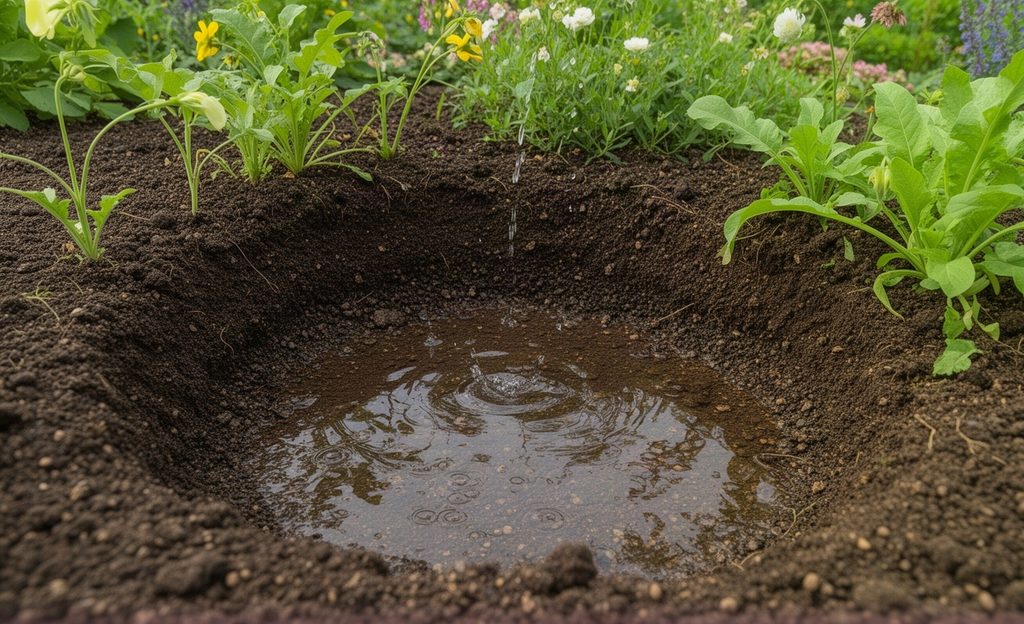
There’s a reason environmental agencies focus on drainage planning as much as landscapers do. Poorly managed runoff causes problems well beyond an individual property. It contributes to erosion and carries pollutants into storm systems. During heavy rain events, it also adds pressure to municipal infrastructure that already has plenty to handle. As the Wikipedia entry on stormwater runoff explains, unmanaged runoff in developed areas drives two connected problems: flooding from the sheer volume and speed of water moving off hard surfaces, and pollution from everything that runoff picks up along the way.
A well-graded, well-drained yard does more than protect one house. It contributes a small part of the work that keeps entire neighborhoods from flooding during a bad storm season. Multiply that by every property on a block that’s been graded correctly, and the cumulative effect on local flooding and water quality is far larger than any single yard would suggest.
Integrating Drainage Into the Design Process
The properties that hold up best over time are the ones where drainage and design were never treated as two separate projects. The smarter sequence starts with a site assessment. Before anything gets finalized, look at where water naturally collects and where the sun hits hardest. Then check what direction the land actually slopes. From there, hardscaping and planting beds get designed alongside the drainage infrastructure. That way, a French drain or swale gets built into the plan from the very start, laid in before the sod goes down. This kind of site-responsive design approach, building around a property’s existing conditions, tends to produce yards that need far less correction a year or two down the line.
Maintenance Keeps Systems Working
Drainage infrastructure has a lifespan just like anything else buried underground. It’s easy to forget that once it’s covered with mulch and sod, out of sight really does mean out of mind. Even a well-designed drainage system will fail eventually if nobody checks on it. Leaves and silt clog French drains and catch basins over time. Root growth adds to the problem, and together they slowly reduce capacity until a storm reveals it all at once.
Downspouts get disconnected or crushed, while grading shifts as soil settles, especially in the first year or two after installation. Sometimes, it even reverses the slope that was supposed to carry water away from the house in the first place. A simple annual walk-through after heavy rain catches most of these issues before they turn into expensive repairs. Look for standing water or slow-draining spots, and check that nothing is blocking the outlets. It’s a fifteen-minute habit that costs nothing and routinely saves homeowners from discovering a failed drain the same week a storm floods a finished basement.
Knowing Who to Call
Different drainage issues call for different specialists, and knowing which one to hire saves both time and money. A landscape designer is the right call for planning how a yard should look and function as a whole, including where drainage infrastructure fits into that layout. A plumber or drainage specialist is better suited to diagnosing and fixing existing pipe or sewer-line problems that are contributing to water buildup.
For projects that involve both a redesign and an underlying water problem, coordinating the two usually separates a lasting fix from a repeat service call two years later, more reliably than hiring one specialist and hoping the other issue resolves itself. When both parties join the same conversation early, even briefly, conflicts tend to surface before they turn into change orders mid-project. A proposed patio sitting exactly where a drain line needs to run is a common example.
Treat Drainage as Foundational
A landscape plan that skips drainage is really a bet against the weather. The properties that age well are the ones where water management was part of the earliest design conversations, long before the first flooded flowerbed ever showed up. Drainage works best as a foundational part of the plan, and treating it that way is what separates a yard that looks good in photos from one that actually holds up through every season it has to face. Ask about the water before the plants go in, and the rest of the plan has a much better chance of staying just as beautiful five years from now as it was on installation day.
